Listen Before You Pay: The Acoustic Diagnostic Techniques Bandung Mechanics Use That Most American Riders Never Learn
There is a skill practiced quietly in service bays across Bandung, Indonesia, that rarely makes it into any owner's manual or dealer pamphlet. It does not require expensive equipment. It does not demand years of formal training before it becomes useful. It requires only a trained ear—and the willingness to pay attention before a small mechanical whisper becomes an expensive mechanical scream.
At Honda Motor Bandung, our technicians process a volume of motorcycles that would be difficult to replicate in most American dealership environments. That sustained, high-frequency exposure to Honda engines in various stages of wear has produced something genuinely valuable: a refined acoustic intuition. These mechanics have learned to detect transmission irregularities, bearing degradation, and chain tension problems not by pulling components apart first, but by listening carefully before a single bolt is turned.
This article is about transferring that knowledge to you—the American Honda owner who may be riding past warning signs every single day without recognizing them.
Why American Riders Often Miss the Early Signals
The riding environment in the United States works against acoustic awareness in several meaningful ways. American highways reward higher speeds, which generate wind noise that masks subtle mechanical sounds. Many American riders wear full-face helmets with integrated communication systems or music, further reducing their ability to hear what the engine is trying to communicate. And frankly, most dealership service advisors in the US are trained to respond to problems that have already become visible or measurable—not to coach customers on pre-failure sound recognition.
In Bandung, the dynamic is different. Urban traffic conditions mean motorcycles frequently operate at lower speeds, in stop-and-go patterns, with the engine cycling through a full range of loads and RPMs. That environment is acoustically rich. Technicians who work on bikes brought in from those conditions have developed a diagnostic vocabulary built almost entirely around sound. They know what healthy sounds like. More importantly, they know exactly when something begins to sound wrong.
The Transmission Tell: A Subtle Clunk That Most Riders Dismiss
One of the most commonly missed early warning sounds on a Honda motorcycle is a faint, irregular clunking sensation during gear engagement—particularly when shifting from neutral into first, or when downshifting under moderate engine braking. Many American riders interpret this as normal Honda character, especially on older models. Bandung technicians have a different read.
When a clunk during gear engagement becomes slightly more pronounced than it was six months ago, or when it occurs more frequently at lower temperatures, that is often an early indicator of transmission dog wear. The dogs—small protrusions on the gear faces that lock gears into engagement—begin to round off with accumulated mileage. Early-stage rounding produces a sound that is easy to rationalize away. Late-stage rounding produces missed shifts, false neutrals, and ultimately a transmission rebuild that costs multiples of what an earlier intervention would have required.
The practical test: shift through all gears in a quiet parking lot, engine fully warmed, with your helmet visor open. Listen for the quality of each engagement. Clean shifts should sound crisp and definitive. A mushier, more drawn-out engagement sound is worth noting and tracking over subsequent rides.
Bearing Degradation: The High-Frequency Hum You Should Never Ignore
Wheel bearings and steering head bearings on Honda motorcycles have a distinct acoustic signature when they begin to fail. The sound is a high-pitched, faintly metallic hum that changes in pitch or intensity with vehicle speed—not with engine RPM. That distinction is critical. If the sound tracks your speed rather than your throttle position, the source is almost certainly rotational and load-bearing rather than engine-internal.
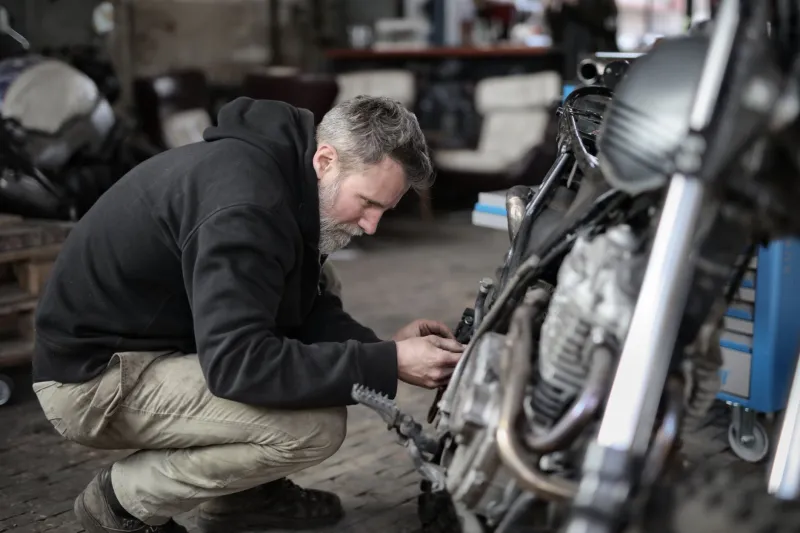
In Bandung's service bays, technicians often identify early bearing wear during the initial walk-around inspection, before the owner has even described a complaint. The method is straightforward: with the motorcycle on a center stand or paddock stand, spin each wheel by hand and listen. A healthy bearing produces almost no sound. A bearing in early degradation produces a faint grinding or roughness that is tactile as much as audible—you feel it in the resistance of the spin as much as you hear it.
For American riders, this is a test that can be performed in any garage in under three minutes. It costs nothing. It can identify a bearing that, left unaddressed, will eventually contaminate surrounding components and turn a $40 bearing replacement into a $200 hub repair.
Chain Tension and the Sound of Preventable Wear
Chain-driven Honda motorcycles produce a very specific sound when chain tension drifts out of specification. At low speeds—particularly when rolling slowly through a parking lot or navigating a tight turn—a chain that is too loose produces a rhythmic slapping sound against the swingarm or chain guide. Many riders hear this and assume it is environmental debris or road noise. It is neither.
A loose chain does not just make noise. It accelerates sprocket wear at a rate that is disproportionate to the degree of slack. Bandung technicians have documented cases where a chain running just a few millimeters outside the recommended tension range caused sprocket wear that would normally require 20,000 miles of normal operation—in under 8,000 miles. The chain itself may look serviceable. The sprockets tell a different story.
Conversely, a chain adjusted too tightly produces a different sound: a high-frequency buzzing or droning at mid-RPM that is often mistaken for a heat shield rattle or exhaust resonance. If that sound disappears when the motorcycle is on a stand with the rear wheel unloaded, chain over-tension is a strong candidate.
Your Honda owner's manual specifies the correct chain slack measurement for your model. Checking it takes two minutes and a ruler. The sound test above gives you a reason to check when your service interval is not yet due.
Building Your Own Diagnostic Baseline
The most important thing Bandung's experienced technicians have that most American riders lack is not technical knowledge—it is a baseline. They have heard the same engine in good health and in progressive stages of wear. That comparison is what makes early detection possible.
You can build your own baseline. On your next ride, find a quiet stretch of road or an empty parking lot and spend five minutes simply listening to your Honda at various speeds and throttle positions. Notice what normal sounds like today. Make a mental note—or an actual note in your service log—of the acoustic character of your bike when everything is confirmed to be in good working order.
When something changes from that baseline, you will notice. And noticing early is almost always the difference between a minor service visit and a major repair bill.
At Honda Motor Bandung, we believe that an informed rider is a better-protected rider. The diagnostic culture that our technicians have developed over years of high-volume service work is not proprietary knowledge. It is practical wisdom—and it belongs to every Honda owner willing to listen.