Moisture, Corrosion, and the Quiet Collapse: What Bandung's Fuel System Battles Teach American Honda Owners
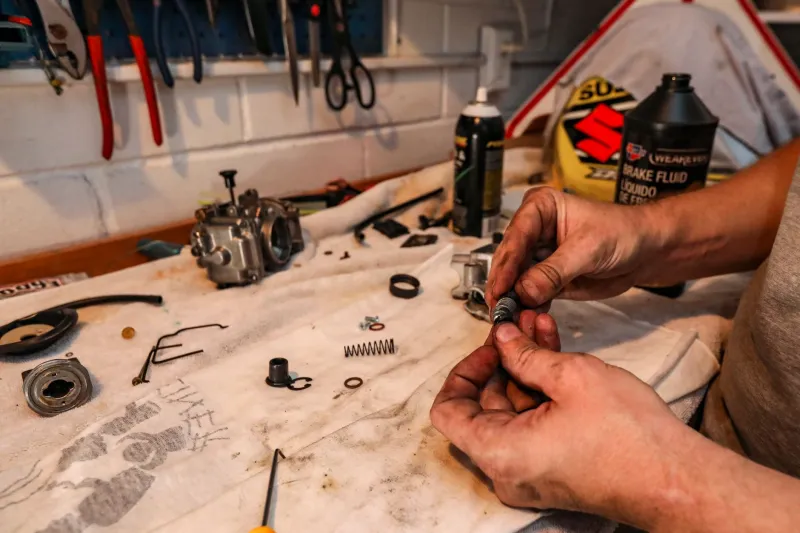
There is a particular kind of mechanical failure that frustrates even experienced technicians: the kind that builds silently over months, leaves no dramatic warning signs, and then arrives as a complete surprise when the motorcycle refuses to start or surges unpredictably at highway speed. In Bandung, Indonesia, where relative humidity regularly exceeds 85 percent and rainfall is a near-daily occurrence, Honda service technicians have become specialists in identifying exactly this pattern. The culprit, more often than not, is the fuel system—and the agent of destruction is moisture.
American Honda riders may not share Bandung's tropical geography, but the lessons earned in those humid service bays carry weight well beyond Southeast Asia. Fuel system contamination is not exclusively a tropical problem. It is a maintenance problem, and one that the American riding community has historically underestimated.
How Moisture Finds Its Way Into a Sealed System
At first glance, the idea of water infiltrating a motorcycle's fuel system seems counterintuitive. The tank is sealed, the fuel lines are closed, and modern Honda fuel injection systems are engineered to tight tolerances. What, exactly, is the entry point?
The answer lies in a process called condensation cycling. Every time a partially filled fuel tank cools after a ride, the air space above the fuel contracts, drawing in ambient air through the tank's venting system. In high-humidity environments, that incoming air carries significant moisture. Over time, this moisture accumulates as microscopic water droplets along the tank's interior walls. In Bandung's climate, technicians at Honda Motor Bandung observe this process accelerating dramatically during the rainy season, when ambient humidity spikes and temperature differentials between a hot engine and cool evening air are at their greatest.
Ethanol-blended fuels, which are standard across most of the United States, compound the problem considerably. Ethanol is hygroscopic—it actively absorbs water from the surrounding environment. Once water content in the fuel mixture reaches a certain threshold, phase separation occurs: the ethanol and water separate from the gasoline and sink to the bottom of the tank, forming a corrosive layer that contacts metal surfaces directly. American riders using E10 or E15 blends, particularly those who store their motorcycles during winter months, are exposing their fuel systems to exactly this risk.
The Cascade of Consequences
Bandung's technicians describe fuel system degradation as a cascade rather than a single event. The process rarely announces itself with a sudden breakdown. Instead, it progresses through stages that are easy to misattribute to other causes.
The first signs are subtle: slightly rough idle, hesitation during acceleration, or a marginal drop in fuel economy that a rider might dismiss as a reflection of traffic conditions or riding style. Internally, however, the injectors are beginning to clog with varnish deposits left behind as contaminated fuel evaporates. The fuel filter, if not replaced on schedule, becomes a reservoir for particulate matter and moisture. The fuel pump, working harder to push degraded fuel through a partially obstructed system, begins to wear prematurely.
Left unaddressed, this cascade leads to injector failure, pump replacement, and in severe cases, tank corrosion that requires either professional treatment or full replacement. In Bandung, where high-mileage commuter motorcycles operate under relentless daily stress, technicians have documented fuel system repairs that could have been prevented entirely with consistent preventative maintenance. The cost differential is significant: a routine fuel system service runs a fraction of the expense associated with injector replacement or pump failure repair.
Diagnostic Signals American Riders Should Not Ignore
One of the practical contributions that Bandung's service experience offers to American owners is a clearer framework for early diagnosis. Rather than waiting for a check engine light or a hard no-start condition, riders should monitor several behavioral indicators that suggest fuel system stress.
Difficulty starting after the motorcycle has sat for more than a week is a meaningful early signal, particularly if the issue resolves after a few cranking attempts. This pattern often indicates that fuel is draining back from the injector rail due to a weakening fuel pump or a compromised fuel pressure regulator. Intermittent stalling at low speeds or during deceleration can point to injector fouling. A noticeable change in throttle response—where the engine feels slightly flat or uneven during steady-state cruising—may indicate partial injector blockage.
Riders who use their motorcycles seasonally should pay particular attention to fuel condition after storage. Fuel that has been sitting in a tank for more than 30 days begins to degrade chemically, and the moisture absorption process continues throughout the storage period. Draining the tank before long-term storage, or using a quality fuel stabilizer, is a practice that Bandung technicians recommend without exception.
The Preventative Framework: What a Proper Fuel System Service Includes
In Bandung's high-volume Honda service environment, fuel system maintenance is treated as a structured, interval-based discipline rather than a reactive measure. American owners accustomed to waiting for symptoms before scheduling service would benefit from adopting a similar framework.
A comprehensive preventative fuel system service should include inspection and replacement of the fuel filter at manufacturer-recommended intervals—or sooner if the motorcycle operates in dusty environments or uses ethanol-blended fuel regularly. Injector cleaning, either through professional ultrasonic service or high-quality fuel system additives used on a consistent schedule, addresses varnish accumulation before it reaches critical levels. Fuel pump output pressure testing, a quick diagnostic step that many American dealerships skip during routine service, provides early warning of pump degradation.
For riders in regions with cold winters—the Upper Midwest, the Northeast, the Mountain West—the pre-storage and post-storage service appointments are particularly important. Running a fuel system cleaner through the engine at the end of the riding season, and inspecting the fuel filter and tank interior at the beginning of the next, costs relatively little in time and money compared to the repairs that neglect invites.
Rethinking the Fuel System as a Priority
American motorcycle culture has long emphasized performance modifications, aesthetic customization, and tire and brake maintenance as the pillars of responsible ownership. Fuel system health rarely receives equivalent attention in popular riding media or community discussions. Yet in Bandung, where Honda motorcycles serve as primary transportation for hundreds of thousands of daily commuters, the fuel system is understood as the circulatory core of the machine—and treated accordingly.
The economic argument is straightforward. Preventative fuel system maintenance, performed consistently, adds years to injector life, preserves fuel pump integrity, and sustains the engine efficiency that Honda engineers designed into the motorcycle from the factory. Deferred maintenance, by contrast, introduces failure points that compound over time and ultimately demand expensive intervention.
At Honda Motor Bandung, the philosophy is simple: a motorcycle that receives consistent, informed care is a motorcycle that performs reliably and retains its value. The fuel system is not a secondary concern. It is, in many respects, where long-term Honda ownership is won or lost—and Bandung's technicians have the service records to prove it.