Disconnected and Costly: How Information Gaps Are Draining American Honda Riders' Wallets—And What Bandung Dealers Do Differently
Photo: Lance Cpl. David Hersey, Public domain, via Wikimedia Commons
There is a particular kind of frustration that comes from a repair bill you never saw coming. Not the dramatic failure—the seized engine, the cracked frame—but the slow, quiet accumulation of missed intervals, wrong-grade fluids, and parts that were almost right. For a significant number of American Honda riders, this frustration is not a matter of bad luck. It is a structural problem built into the way motorcycle dealerships communicate, or more accurately, fail to communicate, across the United States.
At Honda Motor Bandung, we have spent years observing what happens when a dealer network operates with genuine information discipline. The contrast with what many American riders experience is striking—and expensive.
The Fragmentation Problem Nobody Talks About
The United States has no shortage of Honda dealerships. From Seattle to Miami, riders can find authorized service centers within a reasonable distance of almost any major metropolitan area. What those dealerships frequently lack, however, is a shared language. A rider who purchases a CB500F in Phoenix, moves to Nashville, and then relocates to Portland may interact with three entirely separate service ecosystems—each with its own record-keeping format, its own parts sourcing preferences, and its own diagnostic conventions.
When a technician in Portland opens the service history on that CB500F, he may be looking at paper printouts from one dealer, a digital export that doesn't integrate with his shop's management software, and a gap of eighteen months where the owner handled maintenance independently. The result is a diagnostic starting point that is, at best, incomplete. At worst, it leads to redundant services, missed intervals, and parts recommendations based on assumptions rather than verified history.
This is not a criticism of individual technicians. Most Honda service professionals in the United States are skilled and conscientious. The problem is systemic. The information infrastructure simply was not built to follow the rider.
How Bandung's Integrated Network Changes the Equation
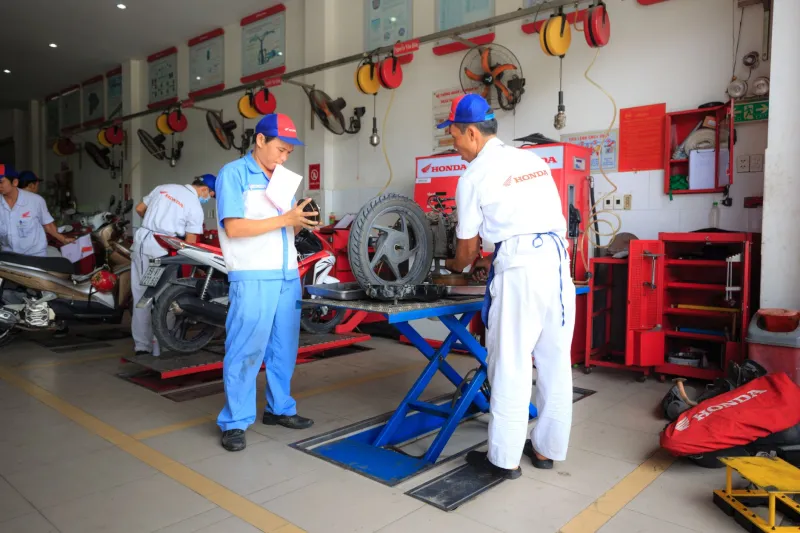
In the Bandung metropolitan area, Honda dealerships operate within a regional framework that treats information as a shared asset rather than a proprietary record. When a motorcycle enters any participating service center in the network, its history is accessible—service dates, mileage at each visit, parts replaced, fluid specifications used, and any diagnostic flags raised during previous inspections.
This architecture produces measurable results. Technicians at Honda Motor Bandung, for example, can identify patterns across a single motorcycle's lifetime rather than making educated guesses based on a single visit. If a particular model consistently shows early valve clearance drift under the riding conditions common to Bandung's congested urban environment, that knowledge circulates through the network. Recommendations become calibrated to actual local conditions rather than generic manufacturer schedules.
The economic benefit to the owner is direct. Catching a minor coolant concentration issue during a routine service costs a fraction of what a warped head costs six months later. Identifying that a specific chain and sprocket combination wears faster on a particular model under stop-and-go conditions allows a proactive replacement rather than a roadside breakdown. Information, in this context, is not administrative overhead. It is preventive maintenance.
The Parts Compatibility Trap
One of the most quietly damaging consequences of information fragmentation is the parts recommendation problem. Honda produces an enormous range of motorcycles, and the correct specification for a component—oil viscosity, brake pad compound, tire pressure rating—can vary significantly between model years, trim levels, and regional variants. A technician working from incomplete records may select a part that fits physically but performs outside optimal parameters for that specific machine.
In Bandung's integrated system, parts recommendations are cross-referenced against the vehicle's full specification profile, not just its visible model badge. This matters because the difference between a part that is close and a part that is correct is often invisible at installation and only apparent after several thousand miles of wear.
American riders are not powerless against this problem, but addressing it requires deliberate effort on their part.
Practical Steps American Riders Can Take Today
The most effective thing an American Honda owner can do is become the custodian of their own information. This means maintaining a personal service log—digital or physical—that travels with the motorcycle regardless of which dealer performs the work. Every service visit should produce a written record that includes the date, odometer reading, specific services performed, parts installed with part numbers where available, and the technician's observations.
When visiting a new dealer, present this record proactively. A good service advisor will incorporate it into their diagnostic process. If a dealer shows no interest in your service history before making recommendations, that itself is useful information about the quality of care you are likely to receive.
Beyond personal record-keeping, riders should ask their primary dealer directly: does this shop participate in any regional or national Honda service network that allows record sharing between locations? The answer will tell you a great deal about how seriously that dealer takes longitudinal care versus transactional service.
For riders who travel extensively, establishing a relationship with a single primary dealer—even if logistics require occasional visits elsewhere—creates a home base for your motorcycle's information history. That dealer becomes your advocate within the broader network, someone who knows your machine's patterns and can flag anomalies that a one-time service visit would never catch.
The Cost of Staying Disconnected
The average American motorcycle owner spends somewhere between $500 and $1,500 annually on maintenance and unexpected repairs, depending on riding frequency and model complexity. A meaningful portion of that expenditure, industry observers suggest, is attributable to redundant services, incorrect parts, and repairs that could have been prevented with earlier intervention.
None of that is inevitable. It is the predictable outcome of a system where information does not flow efficiently between the people who know the most about a motorcycle and the people who need to act on that knowledge.
What Honda Motor Bandung's regional model demonstrates is that the technology and the organizational will to solve this problem already exist. The question for American riders is not whether a better system is possible. It is whether they are willing to take the steps available to them now while advocating for the structural improvements their dealer networks should be building.
Your Honda is a long-term investment. The information that surrounds it deserves the same protection.