Your Break-In Habits Are Already Writing the Resale Listing
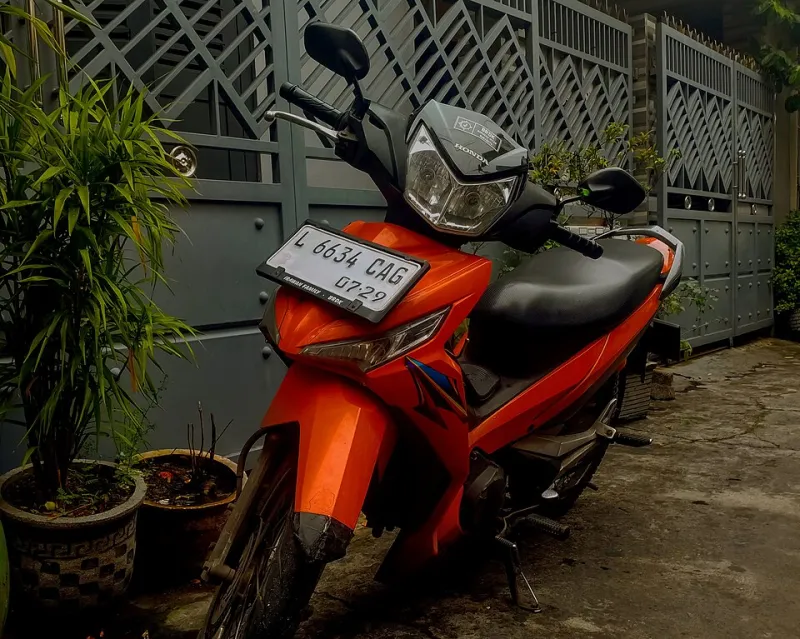
Photo: Rubah Hitam Vukova, CC BY-SA 4.0, via Wikimedia Commons
There is a common assumption among American riders that break-in is a formality. The owner's manual gives a rev limit, the rider observes it for a few hundred miles, and then the motorcycle is treated as fully mature. That approach is not wrong so much as incomplete. The first 500 miles are not only a wear-in period for the engine. They are the opening chapter of the motorcycle's ownership record, and that chapter is read by people you have not met yet.
At Honda Motor Bandung, the service desk sees this distinction clearly. A new motorcycle arrives with a date, a mileage, and a first service. The way that first service is documented becomes part of the bike's identity. In Indonesia, where dealership networks are dense and humidity makes maintenance visible, riders tend to understand that records are not paperwork for their own sake. They are evidence. American riders often have more access to self-service and more freedom to modify, but they also tend to lose the paper trail that proves the first 500 miles were handled with care.
The First 500 Miles Are a Contract, Not a Ceremony
The argument here is simple: break-in is a contract with your future buyer. The engine may survive careless break-in and still run for years. Modern Hondas are built to tolerances that make catastrophic break-in failures rare. But survival is not the same as provenance. A future buyer is not only asking whether the engine runs. The buyer is asking whether the owner paid attention when attention was most useful.
The first 500 miles establish a baseline. They include the first heat cycles, the first varied loads, the first check of fluid levels, and the first service. A rider who treats that period as a checklist creates a record. A rider who ignores it creates a gap. The gap may not hurt the motorcycle in the short term, but it can hurt the resale conversation later.
What Break-In Actually Asks of the Machine
Break-in is often reduced to a single instruction: keep the revs low. That is part of it, but it is not the whole story. Honda's owner's manuals typically ask for moderate throttle, varied engine speeds, and avoidance of prolonged constant-speed running during the early miles. The reason is not mysterious. New components need to seat and shed initial wear particles. Heat cycles help materials settle. Varied loading is better than a long highway drone because it exercises the engine through different pressure and temperature conditions.
A rider does not need to overthink this. The owner's manual is the authority for the specific model. What matters is that the first 500 miles are treated as a period of deliberate operation rather than a period of inconvenience. Vary the roads. Avoid holding one speed for too long. Let the engine heat and cool. Check the oil and coolant. Bring the bike in for the first service at the recommended interval.
The Bandung Habit: Treat the First Service as an Opening Entry
In Bandung, the first service is not usually treated as a nuisance. It is treated as the moment when the motorcycle's maintenance history begins. The date, mileage, fluids, and any observations are recorded. If an owner later sells the bike, that first entry tells a buyer that the motorcycle was attended to during the period when many problems are easiest to prevent.
This is a cultural difference more than a technical one. American riders often perform their own oil changes, which is perfectly reasonable. But self-service becomes a problem when it leaves no record. A receipt for oil and a filter is better than nothing. A notebook with the date and mileage is better than a vague memory. A photo of the odometer at the first service is better than either. The point is not to create a showpiece file. The point is to preserve evidence that the first 500 miles were not ignored.
Why the Future Buyer Cares More Than You Think
A used-motorcycle buyer in the United States is often advised to look for maintenance records. That advice is usually applied to major services, but the first service matters because of what it represents. It shows that the owner was engaged early. A bike with 4,000 miles and no first-service record is not necessarily neglected, but the buyer has no way to know. The buyer may discount the price to account for that uncertainty.
The same buyer will also notice the condition of the motorcycle. A chain that was adjusted during break-in, tires that were checked for pressure, and an engine that was not subjected to a long constant-speed drone all leave subtle signs. The records and the condition reinforce each other. One without the other is weaker.
Three Habits That Make the Contract Legible
First, vary the riding environment. Use secondary roads, gentle acceleration, and different speeds rather than a single highway cruise. Second, document the first service even if you perform it yourself. Keep the receipt, note the mileage, and record the date. Third, avoid early modifications that complicate the story. A slip-on exhaust or an aftermarket intake installed before the first service may not be harmful, but it makes the ownership record harder to read.
A fourth habit is useful but often overlooked: write down what you notice. If the engine feels tight when cold, if the transmission is stiff for the first few miles, or if the coolant level changes slightly, record it. A future buyer may never read those notes, but their presence signals that the owner was paying attention.
The Counterargument: Modern Engines Are Tough
A reasonable rider might object that modern Honda engines are durable enough that break-in is mostly a precaution. That is largely true. The argument here is not that a poorly broken-in engine will fail. It is that break-in habits are one of the few early opportunities an owner has to create a credible record. The motorcycle itself may be forgiving. The resale market is not. Buyers pay for certainty, and certainty is built from evidence.
The first 500 miles are not just a warm-up for the engine. They are the opening entry in a document that a future buyer will read. Bandung's maintenance culture treats that entry as part of ownership. American riders can do the same by riding deliberately, servicing on time, and keeping the record. The motorcycle will run either way. The difference is what the next owner sees.