Forged in the Monsoon: Why Tropical Maintenance Protocols Make Bandung-Serviced Hondas Exceptionally Durable for American Riders
There is a particular kind of reliability that can only be earned through adversity. Engineers understand this principle well—stress testing reveals weaknesses that laboratory conditions never expose. For Honda motorcycles, the city of Bandung and the broader Indonesian climate function as one of the world's most rigorous real-world test environments, and the maintenance protocols developed to keep bikes running through that environment have produced a durability standard that American riders are only beginning to appreciate.
This is not a theoretical argument. It is a mechanical reality grounded in the specific demands that tropical conditions place on every major system of a motorcycle, and in the service practices that Bandung's technicians have refined over decades of managing those demands.
Understanding What Indonesian Climate Actually Does to a Motorcycle
Bandung sits at approximately 2,400 feet above sea level in West Java, a geography that produces a climate characterized by high humidity year-round, temperatures that rarely fall below 65°F and frequently exceed 85°F, and a monsoon season that delivers sustained, heavy rainfall for months at a time. Road conditions range from well-maintained urban corridors to unpaved rural routes with standing water, deep particulate contamination, and surfaces that challenge suspension and sealing systems constantly.
For a motorcycle, this environment functions as a continuous stress test across every system that matters. Electrical connections face persistent moisture infiltration. Fuel systems contend with humidity-laden air that affects combustion consistency. Rubber seals and gaskets experience the accelerated aging that heat and UV exposure produce. Bearings operate in environments where water intrusion is a recurring threat rather than an occasional one. Corrosion is not a long-term concern—it is an immediate and active adversary.
American riders in temperate climates—the Midwest, the Mountain West, much of the Northeast—operate in conditions that are, by comparison, forgiving. Seasonal riding limits annual exposure hours. Garaging practices reduce moisture contact. Moderate temperatures slow the degradation processes that tropical environments accelerate. This relative gentleness, paradoxically, can create a false sense of security about maintenance intervals and system integrity.
Electrical Systems: Where Tropical Conditioning Pays the Largest Dividend
Of all the systems that benefit from tropical maintenance discipline, the electrical architecture of a Honda motorcycle may show the most significant improvement. Bandung technicians service electrical connections with a frequency and thoroughness that exceeds what most American shops would consider standard practice.
Connector inspections, dielectric grease applications, and wiring harness checks are performed at intervals calibrated to the assumption that moisture is always present and always seeking pathways into the system. This approach produces electrical systems that have been repeatedly verified, treated against corrosion, and confirmed to maintain proper contact resistance across all critical circuits.
When a bike serviced under these protocols arrives in an American climate, its electrical system carries a margin of integrity that a comparable bike serviced only in dry conditions may lack. The connectors have been treated. The grounding points have been verified. The wiring has been inspected for chafing and insulation degradation. The result is a bike that handles the seasonal moisture fluctuations of American riding—spring rains, coastal humidity, storage through winter—with considerably less vulnerability.
Fuel Systems: The Discipline of High-Humidity Operation
Humidity affects fuel systems in ways that are subtle but cumulative. Moisture that enters a fuel tank through the venting system can promote microbial growth, accelerate tank corrosion, and introduce water into the fuel delivery path. In Indonesia's climate, these risks are not hypothetical—they are managed actively as part of routine service.
Bandung technicians inspect fuel caps and venting systems for seal integrity at intervals that would seem excessive in drier climates. Fuel filters are replaced on schedules that account for the higher contamination risk of humid environments. Injector function is verified more frequently, and fuel system cleaning protocols are applied proactively rather than reactively.
For American riders who store their bikes during winter months—a practice that creates its own fuel system vulnerabilities through ethanol-blend fuel degradation and moisture accumulation—a Honda that has been maintained under tropical fuel system protocols arrives with a service history that reflects genuine rigor. The components have been tested against conditions that American storage seasons approximate, and they have been maintained accordingly.
Seals, Bearings, and the Geometry of Sustained Stress
Fork seals, wheel bearings, swingarm pivots, and steering head bearings all share a common vulnerability: they are designed to exclude contamination, and they degrade when that exclusion fails. In Bandung's riding environment, contamination pressure is constant. Wet roads deposit particulate matter against every seal face. Thermal cycling from hot ambient temperatures to cool monsoon rain stresses elastomers repeatedly. Bearings that would last years in a dry climate face accelerated wear timelines.
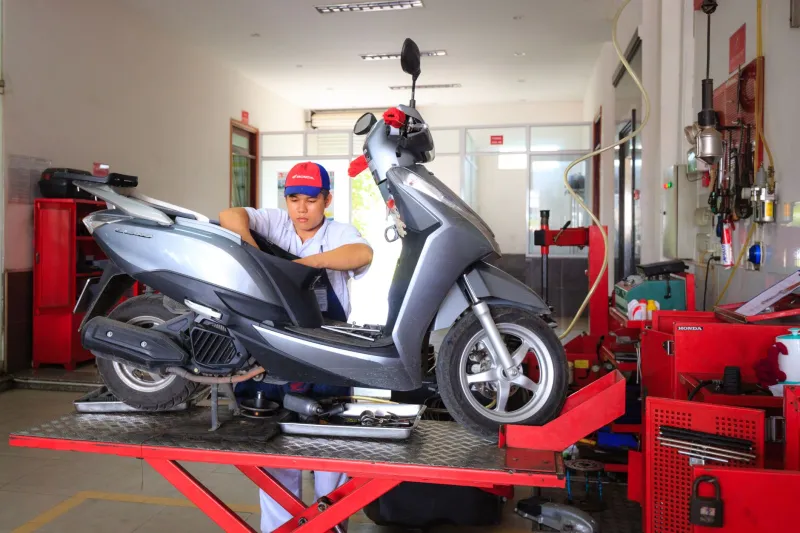
The maintenance response to this reality is a service culture that treats seal and bearing inspection as a priority rather than an afterthought. Technicians at Honda Motor Bandung assess fork seal condition visually and through feel at every service visit. Wheel bearings are checked for play and noise at intervals that would seem conservative by American standards. Swingarm and steering components receive lubrication and inspection on schedules calibrated to the demands of the environment.
A bike that emerges from this service culture carries bearings and seals that have been repeatedly assessed and either confirmed serviceable or replaced before failure. The result is a suspension and steering system with known, documented integrity—a significant advantage for any American buyer evaluating a used Honda with a Bandung service history.
Why American Riders Should Read Bandung Service Records Differently
The conventional American approach to evaluating a motorcycle's service history focuses on whether routine maintenance was performed at appropriate mileage intervals. Oil changes, tire replacements, brake inspections—these are the standard checkpoints. This framework is adequate for bikes maintained in temperate conditions with predictable wear patterns.
A Bandung service record represents something more comprehensive. It reflects maintenance performed against a background of conditions that stress every system simultaneously and continuously. The intervals are tighter. The inspection scope is broader. The component replacement thresholds are more conservative. When a Bandung technician signs off on a Honda as fit for service, that assessment has been stress-tested by the environment itself.
For American riders, this translates into a practical reliability advantage. The electrical system is more thoroughly treated. The fuel system is more carefully monitored. The seals and bearings have been assessed against a higher standard of scrutiny. The bike, in short, has been maintained as though conditions demanded it—because they did.
That is the climate advantage. It is not marketing language. It is the mechanical consequence of operating and maintaining motorcycles in one of the world's most demanding environments, and it is a standard that Honda Motor Bandung applies to every bike that passes through its service bays.