When Cheap Parts Cost Everything: How Bandung Technicians Unmask Inferior Honda Components Before They Strand American Riders
The roadside breakdown rarely announces itself in advance. For many American Honda riders, the first indication that something is wrong arrives as a sudden loss of braking response on a freeway ramp, an engine that stumbles and dies on a rural highway, or a transmission that locks mid-shift on a weekend ride. In a significant number of these cases, investigators tracing the failure back to its origin find the same culprit: a non-OEM component installed during a previous service, purchased online for a fraction of the Honda-genuine price.
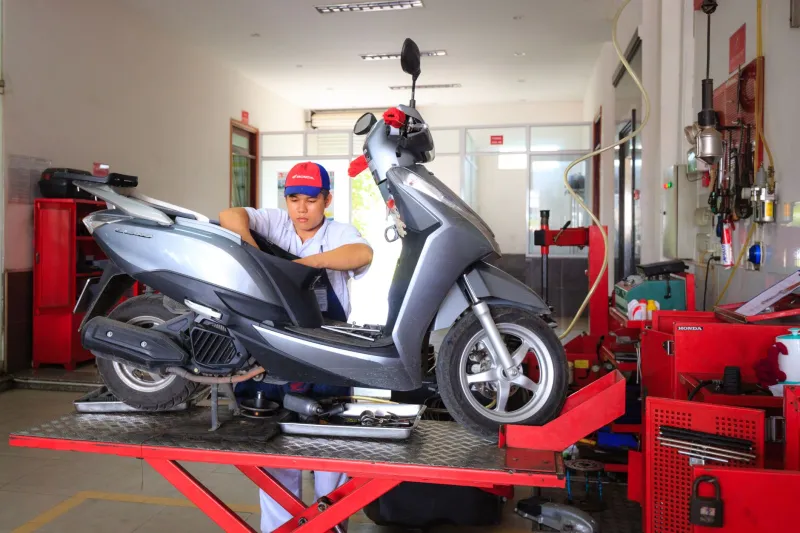
At Honda Motor Bandung, technicians encounter this problem with enough regularity that the dealership has developed a structured, repeatable process for identifying suspect parts—both on bikes coming in for diagnosis and in the supply chain before components ever reach the service bay. Understanding that process can help American riders make smarter decisions before the consequences become expensive or dangerous.
The Scale of the Problem in the American Market
The United States aftermarket parts industry is enormous, and the online retail environment has made it easier than ever for counterfeit and low-grade components to reach consumers without meaningful friction. A rider searching for Honda brake pads, fuel filters, or cam chain tensioners on a major e-commerce platform will encounter dozens of listings that appear credible—complete with Honda-adjacent branding, professional photography, and competitive pricing.
The challenge is that appearance and price are the two metrics most easily manipulated by manufacturers of inferior goods. A counterfeit brake pad can be packaged in a box that closely resembles OEM Honda packaging. A substandard fuel filter can carry dimensions that match the genuine part specification. The differences that matter—metallurgical composition, friction coefficients, filtration micron ratings, seal integrity—are invisible to the naked eye at the point of purchase.
For American riders who service their own bikes or rely on independent shops with less rigorous supply chains, the exposure to these components is substantial.
What Bandung's Technicians Look For First
In Bandung's service environment, where technicians process a high volume of motorcycles across a wide range of conditions, the identification of non-OEM parts has become almost instinctive. But the instinct is built on concrete criteria that can be taught and transferred.
Surface finish and material consistency are among the first indicators. Genuine Honda components are manufactured to tight tolerances with consistent surface treatments. A brake rotor, for example, should have a uniform machine finish without visible casting irregularities, pitting, or inconsistent thickness across its surface. Counterfeit rotors frequently show subtle warping, uneven edge finishing, or a metallic composition that appears visually correct but feels different under a calibrated torque wrench.
Fitment precision is another reliable diagnostic. OEM parts are engineered to seat correctly the first time, with no need for persuasion, adjustment, or shimming. When a technician encounters a component that requires force to install, sits slightly off-center, or produces unusual resistance during assembly, that friction—literal and figurative—is a signal worth investigating.
Weight and density tell a story that packaging cannot fabricate. Bandung technicians routinely compare the heft of incoming parts against known-genuine references. A counterfeit bearing or sprocket will frequently be lighter than its OEM counterpart, reflecting cheaper alloy composition or reduced material volume. This is not a sophisticated test. It requires only experience and a calibrated sense of what a genuine part feels like in hand.
The Systems Most Vulnerable to Inferior Components
Not all Honda systems carry equal risk when non-OEM parts are introduced. Based on the failure patterns observed at Honda Motor Bandung, several areas demand particular scrutiny.
Braking components represent the highest safety exposure. Counterfeit brake pads frequently use friction compounds that perform adequately during light use but fade rapidly under sustained or hard braking—precisely the conditions under which reliable performance is most critical. The failure is not always dramatic. Sometimes it manifests as increased stopping distances that the rider attributes to riding conditions rather than component degradation.
Fuel system components—filters, injector seals, and fuel pump assemblies—are vulnerable to quality shortcuts that affect flow rates and filtration efficiency. A substandard fuel filter that allows particulate matter to reach the injectors can cause progressive injector wear that doesn't produce obvious symptoms until the damage is substantial.
Electrical connectors and switches sourced from non-OEM suppliers frequently use inferior contact materials and thinner insulation. In humid American climates—the Pacific Northwest, the Southeast, coastal regions—these connectors corrode faster, produce intermittent faults, and create diagnostic puzzles that consume hours of shop time to resolve.
Cam chain tensioners and timing components represent perhaps the most consequential category. A tensioner that loses spring tension prematurely, or a timing chain with inadequate link strength, can cause engine damage that runs into thousands of dollars to repair.
A Practical Verification Framework for American Riders
The diagnostic expertise that Bandung technicians apply in the service bay translates into a set of purchasing practices that American riders can adopt immediately.
Source from authorized channels. Honda's genuine parts network includes authorized dealers and certified online retailers. Purchasing through these channels does not guarantee zero risk, but it substantially reduces exposure to counterfeits. If a price on an unfamiliar platform is dramatically lower than authorized dealer pricing, that gap warrants skepticism.
Request documentation. Genuine Honda parts come with verifiable part numbers that can be cross-referenced against Honda's official parts catalog. Before accepting any component from a third-party supplier, confirm that the part number on the packaging matches the catalog specification exactly—not approximately.
Inspect packaging integrity. Honda's OEM packaging uses consistent print quality, accurate color reproduction, and precise typography. Blurred text, color inconsistencies, or packaging that feels lighter or thinner than expected are indicators of potential counterfeit origin.
Consult a technician before installation. If there is any uncertainty about a component's authenticity, the cost of a brief technician inspection is trivial compared to the cost of diagnosing a failure caused by an inferior part installed incorrectly or prematurely.
The Bandung Standard as a Benchmark
At Honda Motor Bandung, the commitment to genuine OEM parts is not a marketing position—it is a technical standard built into every service workflow. Technicians are trained to identify suspect components before they enter the service bay, and the dealership's supply chain is structured to eliminate the ambiguity that creates risk for riders.
American riders operating in a more fragmented parts environment can use that standard as a reference point. The question to ask before any parts purchase is simple: would this component pass the scrutiny of a Bandung technician? If the answer is uncertain, it may be worth waiting for a source that makes the answer obvious.
The roadside breakdown is not inevitable. In most cases, it is the downstream consequence of an upstream decision—a decision made at a checkout page, in a parts store aisle, or during a rushed service appointment. Making that decision with the rigor that Bandung's technicians bring to every inspection is the most reliable way to ensure the ride continues.