The Documentation Standard Bandung Dealers Swear By—And American Honda Owners Have Never Heard Of
When an American Honda owner decides to sell their motorcycle, the conversation typically revolves around mileage, visible condition, and whether the title is clean. A buyer shows up, walks around the bike, maybe starts the engine, and a number gets negotiated. What almost never enters that conversation is a detailed maintenance ledger, a modification history, or a parts-origin record. In Bandung, Indonesia, that omission would be considered a serious liability—not a minor oversight.
At Honda Motor Bandung, we have observed firsthand how the documentation habits embedded in Indonesian dealer culture translate into measurable resale premiums. The practices are not complicated. They are simply consistent. And they reflect a fundamentally different philosophy about what a motorcycle's history is actually worth.
Why Resale Conversations Start Differently Here
In Bandung's high-density motorcycle market, buyers are sophisticated. With hundreds of thousands of Honda motorcycles operating across the city at any given time, the used market is intensely competitive. A seller cannot rely on scarcity to justify a price. Instead, value must be demonstrated through evidence.
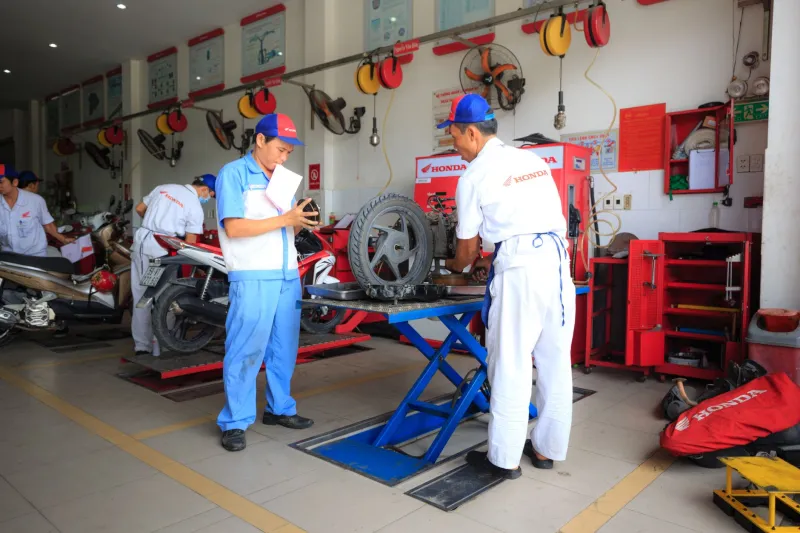
This reality has pushed Bandung dealerships—and the riders who work with them—to develop documentation habits that go well beyond what most American dealers consider standard. When a motorcycle comes in for service here, the record created is not simply a receipt. It is a detailed entry into an ongoing mechanical narrative. Fluid specifications are logged. Component wear measurements are noted. Any deviation from factory tolerance is flagged and explained. The cumulative effect of these entries is a document that tells a prospective buyer precisely how the motorcycle was cared for across its entire service life.
American Honda dealerships generate service records too, of course. But the depth of those records varies dramatically from shop to shop, and the expectation that an owner will preserve and present them at resale is far from universal. In Bandung, presenting that documentation is not optional—it is expected.
The Customization Variable That American Sellers Ignore
One of the most consequential gaps between Bandung and American resale practices involves modifications. Customization is common among Honda riders on both sides of the Pacific, but the way those changes are documented diverges sharply.
In Bandung, any modification performed at or through a Honda-affiliated service center is logged with specificity: the part installed, its origin, its compatibility with the original specification, and whether the change affects warranty status or insurance classification. This creates a traceable record that a buyer can evaluate independently. A well-documented aftermarket exhaust or suspension upgrade, installed with genuine or certified components and properly recorded, can actually add to a motorcycle's resale appeal rather than subtract from it.
In the American market, modifications are far more likely to reduce a buyer's confidence than increase it—not because the work was necessarily poor, but because there is no paper trail to verify quality, origin, or compatibility. A buyer seeing an aftermarket component on an undocumented American Honda has no way to assess whether the change was performed professionally or whether it introduced problems that have since been masked. Suspicion fills the space where documentation should exist.
The lesson here is not that American riders should avoid customizing their Hondas. It is that every modification deserves a written record that travels with the motorcycle. Part number, installation date, shop name, and any factory specification affected should all be captured and preserved.
Specific Metrics That Bandung Dealers Track—and Buyers Reward
Beyond service receipts and modification logs, Bandung dealers apply a set of performance-adjacent metrics that rarely appear in American resale conversations. These include:
Valve clearance history. Honda engines are engineered to precise tolerances, and valve clearance drifts over time. A service record that shows clearance was measured and adjusted at recommended intervals tells a buyer that the engine was managed proactively, not reactively. This single data point signals responsible ownership more clearly than almost any other metric.
Chain wear progression. Drive chain elongation is a reliable indicator of how hard a motorcycle has been ridden and whether it was maintained on schedule. Bandung service records often include chain stretch measurements taken at successive service intervals, providing a longitudinal view of drivetrain stress. American resale conversations almost never include this information.
Brake component wear at each service. Pad thickness and rotor measurements logged over time reveal not just current condition but usage patterns. A buyer can see whether the previous owner was a commuter, a weekend rider, or someone who pushed the motorcycle hard.
Coolant and brake fluid exchange dates. These are among the most commonly skipped maintenance items in the American market, yet their neglect has real consequences for long-term reliability. Documenting exchanges—and the specific fluid specifications used—signals to a buyer that the motorcycle received attentive, knowledgeable care.
None of these metrics require special equipment to track. They require only the habit of asking your service technician to record them and the discipline to keep the resulting paperwork organized.
Building a Bandung-Style Documentation File Before You Sell
If you are an American Honda owner with no existing documentation beyond a handful of dealer receipts, you are not without options. The most important step is to begin now, regardless of how long you have owned the motorcycle.
Start by requesting a comprehensive current-condition inspection from your Honda dealer or a trusted independent shop. Ask for written measurements on valve clearance, brake components, chain wear, and tire tread depth. This establishes a documented baseline even if earlier history is incomplete. A buyer who sees a thorough recent inspection record is reassured, even when older records are absent.
Next, compile whatever existing documentation you do have—receipts, photos of work performed, manufacturer recall completion notices—into a single organized file. Physical folders work. Digital folders work equally well and are easier to share with prospective buyers remotely.
Finally, if you have made any modifications, document them now even if the work was done previously. A written description of what was changed, when, and by whom—supplemented by photos—is considerably better than silence.
What the Gap Really Costs You
The resale value difference between a thoroughly documented Honda and an undocumented one is difficult to quantify with precision, because so many variables affect individual transactions. But the directional truth is consistent: buyers pay more for certainty. Every piece of documentation you provide reduces the uncertainty a buyer must absorb into their offer price.
Bandung dealers understand this intuitively because they operate in a market where buyers demand it. American Honda owners who adopt the same discipline are not simply following an international best practice—they are reclaiming value that currently evaporates in the space between what a motorcycle is worth and what a buyer is willing to risk paying for it.
At Honda Motor Bandung, documentation is not a bureaucratic formality. It is the foundation of trust between a seller and a buyer, between a rider and their machine, and between a dealership and the community it serves. That foundation is available to any Honda owner willing to build it—one service record at a time.