Clean Air, Long Life: What Bandung's Emissions Expertise Means for Your Honda's Future
Most American Honda riders think about emissions controls the way they think about their bike's VIN plate — it's there, it matters legally, and beyond that, it rarely enters the conversation. Oil changes, chain tension, brake pads: these are the pillars of the average US rider's maintenance calendar. What happens inside the fuel injection mapping, the oxygen sensor feedback loop, or the catalytic substrate is largely invisible territory.
In Bandung, Indonesia, that territory is anything but invisible.
Over the past decade, Indonesia has enacted some of Southeast Asia's most demanding emissions certification requirements for two-wheeled vehicles. Every Honda motorcycle sold through a dealer like Honda Motor Bandung must meet Euro 3 and, more recently, Euro 4-equivalent standards — thresholds that demand precise engineering across the entire combustion cycle. The result is a service culture in which technicians are trained not just to keep motorcycles running, but to keep them running clean, with a depth of emissions system knowledge that translates directly into long-term mechanical health.
For American riders paying attention, the implications are significant.
Why Emissions Systems Are Really Reliability Systems
It is worth reframing the conversation before going further. Emissions controls are often discussed as a regulatory burden — something imposed on manufacturers by government agencies. But from an engineering standpoint, a motorcycle that meets strict emissions standards is, almost by definition, a motorcycle whose combustion process is tightly managed.
Fuel trims are accurate. Air-fuel ratios stay within narrow tolerances. The throttle body and injector spray patterns are clean and consistent. Exhaust gases exit at temperatures and compositions that reflect efficient combustion rather than incomplete burning.
When any of these variables drift — when an oxygen sensor begins reading incorrectly, when injector deposits alter spray geometry, when a secondary air injection valve sticks open — the bike fails its emissions check. In Bandung, that failure is caught early, because the infrastructure to catch it exists. In many US markets, that same drift goes undetected for tens of thousands of miles, quietly degrading performance, fuel economy, and internal engine components.
Bandung's Honda technicians are, in effect, trained to read combustion health through the lens of emissions compliance. That is a diagnostic skill with benefits that extend well beyond passing a smog test.
The Diagnostic Depth That Bandung Builds
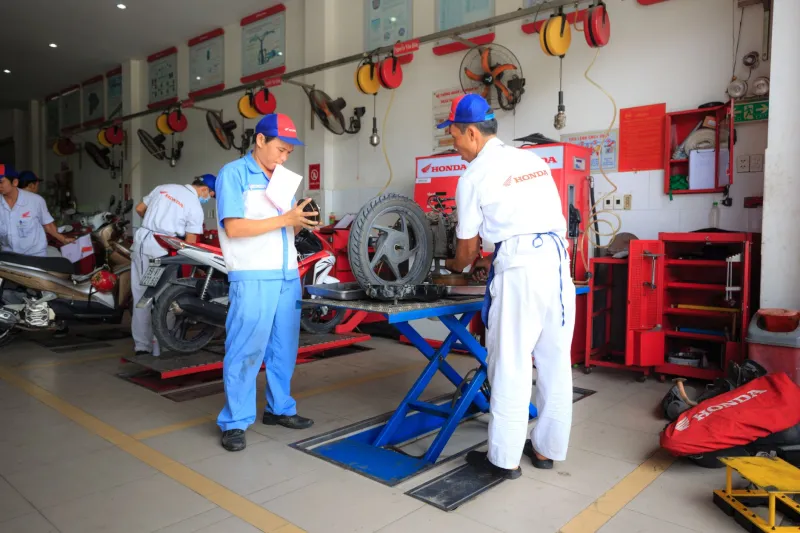
Honda Motor Bandung's service team works with emissions-related systems on a daily basis. This is not occasional or specialized work — it is routine. The Programmed Fuel Injection (PGM-FI) system, the idle air control valve, the heated oxygen sensor, the evaporative emissions canister on applicable models: these components are inspected, calibrated, and serviced with a regularity that builds genuine expertise.
When a technician has diagnosed a hunting idle on dozens of Honda CBR150Rs, traced the fault to a contaminated MAP sensor, recalibrated the ECU, and confirmed the repair through emissions output data, that technician carries a mental model of the system that no training manual alone can provide. Volume and repetition create pattern recognition. Pattern recognition creates faster, more accurate diagnosis.
American Honda owners who have experienced the frustration of a dealer unable to resolve a persistent rough idle, a fuel efficiency drop with no obvious cause, or an intermittent check engine light will understand why this depth of experience matters.
Future-Proofing in a Tightening Regulatory Environment
The United States is not standing still on emissions policy. California's Air Resources Board continues to tighten standards for on-road motorcycles, and federal regulations are moving in a similar direction. Several major metropolitan areas are already discussing low-emission zones that could affect older, poorly maintained bikes.
For a US rider who plans to keep their Honda for the long term — or who intends to sell it at maximum resale value — the condition of the emissions system is becoming an increasingly important factor. A motorcycle with a well-maintained PGM-FI system, clean injectors, a functioning oxygen sensor, and an intact catalytic converter will hold its value better and face fewer regulatory complications than one where these systems have been neglected.
This is precisely the kind of maintenance philosophy that Bandung's service culture has normalized. Not because it is trendy, but because the regulatory environment there demanded it years ago.
What American Riders Can Apply Right Now
You do not need to ship your Honda to Indonesia to benefit from this perspective. What you can do is approach your next service appointment with a different set of questions.
Ask your service center when the oxygen sensor was last inspected and whether it is reading within specification. Ask about injector cleaning intervals and whether your specific model's fuel delivery system has any known long-term wear patterns. Request a review of your ECU's fuel trim data — on any modern Honda with PGM-FI, this information is accessible and tells a detailed story about combustion health over time.
If your service center cannot engage with these questions, that is itself useful information about the depth of expertise available to you.
The technicians at Honda Motor Bandung ask these questions as a matter of course. The emissions standards they work within have made combustion system health a standard agenda item, not an afterthought. American riders who adopt the same mindset will find that their Hondas run better, last longer, and retain more of their value — regardless of what the next round of regulatory changes brings.
Clean combustion is not just an environmental obligation. In Bandung, it has always been understood as the foundation of a reliable, long-lived machine. That understanding is available to every Honda owner willing to ask for it.