From Monsoon Season to Frost Season: Bandung's Wet-Weather Maintenance Playbook for American Riders
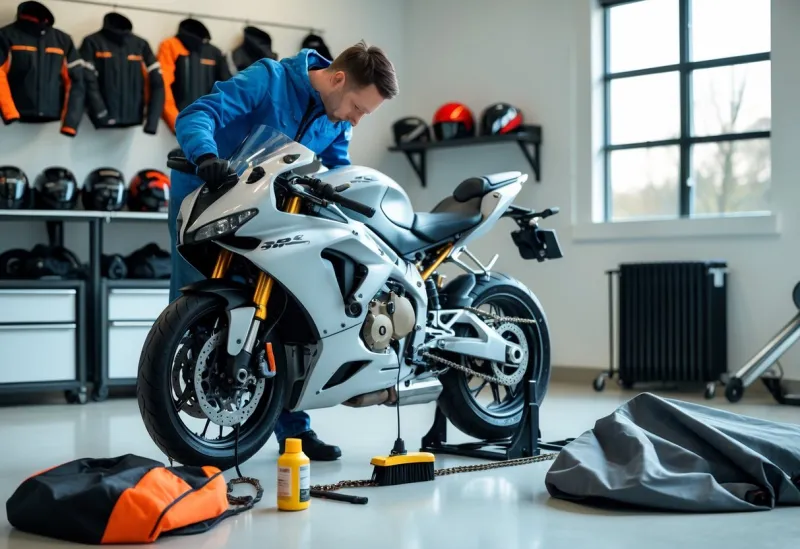
Photo: motorcycle winter storage maintenance garage preparation tools, via koala.sh
Every October, millions of American motorcycle riders face the same ritual: the reluctant roll of their Honda into the garage, the half-remembered advice about fuel stabilizer, and the vague hope that everything will be fine come spring. For most, winterization is a loose collection of habits passed down from other riders, shaped more by tradition than by technical rigor.
In Bandung, Indonesia, there is no off-season to prompt this ritual — but the underlying problem is the same, and it is far more acute. The city sits in a highland basin that receives well over 2,000 millimeters of rainfall annually. Humidity rarely drops below 70 percent. Motorcycles are primary transportation, not recreational vehicles, which means they operate through conditions that would ground most American riders entirely.
The maintenance practices that Honda Motor Bandung's technicians have developed under these conditions are not theoretical. They are the product of solving real failures, on real bikes, in genuinely punishing environments. Translated to the American context — winter storage in Minnesota, coastal riding in the Carolinas, spring thaw in Ohio — they offer a level of specificity that generic winterization guides simply cannot match.
Understanding the Shared Enemy: Moisture and Its Mechanisms
Before discussing technique, it is worth understanding why Bandung's experience is relevant to American winters specifically. The intuitive comparison is heat and humidity versus cold and snow, which seems to suggest little overlap. In practice, the damaging mechanism is nearly identical: moisture penetration into metal joints, electrical connectors, bearing races, and brake components, followed by oxidation and accelerated wear.
In Bandung, that moisture arrives continuously and immediately. In Chicago or Boston, it arrives in cycles — rain in autumn, snow and road salt through winter, thaw moisture in spring. The cumulative exposure is different, but the chemistry of corrosion is the same. What Bandung's technicians have learned to prevent aggressively, American riders encounter in slower motion. The solutions transfer directly.
The Electrical System: Where Moisture Damage Hides
Bandung technicians will tell you, without hesitation, that electrical connectors are the first casualty of a wet environment. Moisture wicks into multi-pin connectors through capillary action, sits against contact surfaces, and creates the conditions for oxidation that increases resistance, causes intermittent faults, and eventually leads to component failure.
The Bandung approach begins with a systematic inspection of every accessible connector before the wet season intensifies. Each connector is separated, inspected for green or white oxidation deposits, treated with an electrical contact cleaner, dried completely, and reassembled with a thin application of dielectric grease before reconnection. This is not a once-in-three-years task — it is annual, minimum.
For American riders preparing for winter storage, this process should happen in the fall, before the bike goes away. Pay particular attention to the connectors serving the fuel injection system, the ABS module if equipped, and the instrument cluster. These are high-consequence circuits where intermittent resistance causes disproportionate problems.
Chain and Drive System: The Monsoon Protocol
A motorcycle chain in Bandung is under constant assault. Road water carries grit and dissolves lubricant continuously. The maintenance response is not simply more frequent lubrication — it is a specific sequence that Bandung technicians apply after any significant wet exposure.
The chain is first cleaned with a dedicated chain cleaner to remove contaminated, water-mixed lubricant. It is then allowed to dry fully — compressed air accelerates this significantly. Only then is fresh lubricant applied, ideally a wax-based chain lube that resists fling-off and provides a barrier against moisture rather than simply filling the gaps between links.
For American riders, this sequence matters most in the weeks before winter storage and again in early spring when road salt residue is still present. Storing a motorcycle with a chain that carries contaminated lubricant is storing a chain that will corrode from the inside out over the winter months. The cleaning step is not optional — it is the step that the lubrication step depends on.
Brake Systems: The Component Americans Overlook Most
In Bandung's wet season, brake calipers see water intrusion around the dust seals daily. The result, if unaddressed, is caliper piston corrosion that causes uneven pad wear, dragging brakes, and, in severe cases, seized pistons. Bandung's service protocol includes caliper inspection and piston cleaning at intervals that would surprise most American riders.
For winter preparation, the relevant practice is this: before storage, compress each caliper piston fully, clean the exposed surface of corrosion and brake dust using brake cleaner and a soft brush, and ensure the pistons retract and extend evenly. If the brake fluid has not been replaced within two years, replace it now. Brake fluid is hygroscopic — it absorbs moisture from the atmosphere — and fluid that has been in service through a wet riding season carries more water than fluid that has not.
This is particularly important for riders in coastal states where salt air accelerates brake system corrosion, and for those in northern states where road salt spray contacts the underside of the bike throughout winter commutes.
Fuel System and Storage Preparation
Bandung technicians do not face long-term fuel storage issues in the way American riders do, but they are deeply familiar with fuel system degradation caused by ethanol-blend fuels in humid conditions. Ethanol absorbs water, and in high-humidity environments, fuel left in a tank or carburetor bowl for extended periods becomes acidic and corrosive.
The Bandung-informed approach for American winter storage: run the fuel level as low as practical, add a quality fuel stabilizer to whatever remains, run the engine for five minutes to distribute the treated fuel through the entire injection system, then shut the fuel off and run the engine until it stalls to clear the fuel rail. On carbureted models, drain the float bowl completely.
This is not new advice, but the reasoning behind it — drawn from daily observation of what ethanol-blend fuel does to fuel system components in humid conditions — reinforces why it should be treated as non-negotiable rather than optional.
The Mindset Behind the Method
What distinguishes Bandung's maintenance culture from the average American rider's approach is not access to exotic tools or proprietary products. It is the conviction that moisture damage is always happening, always progressing, and always preventable with timely intervention.
American riders who adopt that same conviction — who treat fall preparation as a serious technical process rather than a brief annual chore — will find their Hondas emerging from winter in meaningfully better condition. Fewer corroded connectors. Cleaner chains. Brake systems that function as designed from the first spring ride.
The monsoon never stops in Bandung. Winter, eventually, does. That margin of time is an advantage that American riders have, and Bandung's technicians would know exactly how to use it.