Proof Is in the Paperwork: How Bandung-Level Service Records Translate to Real Resale Gains for American Honda Owners
Selling a used motorcycle in the United States is a negotiation shaped largely by trust. A buyer standing in a driveway, examining a Honda CB500F or a CRF300L, is not just evaluating chrome and tires—they are trying to determine whether the previous owner cared for the machine the way it deserved. And increasingly, the riders who command the strongest resale prices are those who can point to a maintenance history that reflects professional-grade discipline. That standard, perhaps surprisingly to some American riders, is one that Honda Motor Bandung has helped define.
Why Maintenance History Moves the Market
The U.S. used motorcycle market is competitive and, at times, unforgiving. Platforms like Cycle Trader, Facebook Marketplace, and local dealer consignment lots are flooded with listings that share similar specs but vary wildly in asking price. The gap between a Honda that sells in three days and one that sits for three months is rarely about the model itself—it is almost always about perceived reliability, which is communicated through service documentation.
Buyers with experience know what they are looking at. A logbook showing oil changes performed at consistent intervals, air filter replacements completed before mileage thresholds are exceeded, and brake fluid flushed on schedule tells a story of an owner who treated the motorcycle as a long-term investment. That story is worth money. Industry observers within the pre-owned motorcycle segment have noted that well-documented bikes can command anywhere from eight to fifteen percent more than comparable machines with incomplete or informal maintenance histories.
The question is: what does "well-documented" actually look like at the highest level?
The Bandung Standard and What It Demands
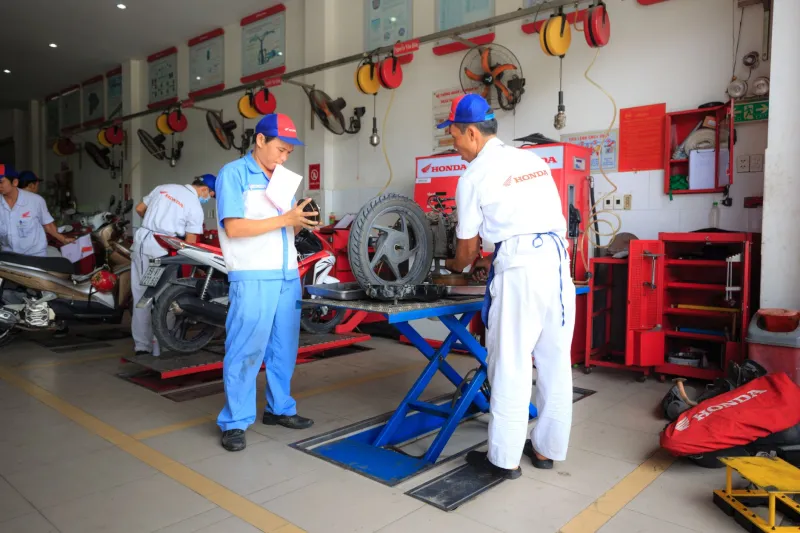
At Honda Motor Bandung, the volume of motorcycles that pass through the service bays on any given week would surprise most American dealers. Bandung is a city of millions, and motorcycle density there is not a lifestyle choice—it is an economic and logistical reality. Technicians in this environment develop a systematic precision that comes not from occasional practice but from daily repetition under demanding conditions.
The tropical climate intensifies every maintenance variable. Heat accelerates fluid degradation. Humidity invites corrosion in places American riders rarely think to inspect. Frequent stop-and-go urban traffic stresses cooling systems and clutch components in ways that highway cruising simply does not replicate. To service a Honda motorcycle in Bandung is to engage with the machine's vulnerabilities at an accelerated pace—and to develop protocols that address them before they become failures.
When those protocols are applied to a motorcycle destined for the American market, the result is a machine that has been stress-tested against conditions far more demanding than a dry California summer or a mid-Atlantic spring. The documentation that accompanies such a bike reflects not just what was done, but when it was done, why it was necessary, and what was found during the inspection.
What American Buyers Are Actually Looking For
Talk to experienced Honda buyers in the U.S., and a clear picture emerges. They want documentation that is specific, not vague. A receipt that reads "oil change completed" is helpful; a record that specifies the oil grade used, the mileage at service, the condition of the drain plug washer, and the technician's notes on valve clearance is valuable. The difference between those two documents is the difference between a buyer who feels reassured and a buyer who feels confident.
Owners who have had their Hondas serviced to the standards maintained at Honda Motor Bandung tend to arrive at the point of sale with the latter. Their service records reflect the kind of granular attention that experienced technicians apply when they are accountable to a professional standard rather than a casual one. American buyers—especially those purchasing their second or third Honda—recognize that level of documentation immediately.
One pattern that appears consistently in owner-to-owner sales: bikes with detailed, professional service histories spend significantly less time listed before finding a buyer. The time savings alone has real monetary value for a seller who would otherwise field weeks of lowball inquiries.
Resale Value as a Maintenance Metric
There is a useful way to reframe the maintenance conversation for American Honda owners who are deciding how seriously to take their service intervals: think of every professional service appointment as a deposit into a resale account. The discipline required to bring a motorcycle in on schedule, to use genuine Honda parts, and to maintain organized records is not just about keeping the engine healthy today. It is about ensuring that the bike's history speaks for itself when it is time to sell.
This perspective is deeply embedded in how Indonesian Honda owners approach their machines. In a market where motorcycles serve as primary transportation rather than weekend recreation, the financial logic of proper maintenance is immediately apparent. A bike that breaks down is not an inconvenience—it is a disruption to livelihood. That urgency produces habits that American owners, who often have the luxury of a backup vehicle, may not develop naturally.
Adopting the mindset does not require experiencing that same urgency. It simply requires understanding that the resale market rewards exactly the behavior that good maintenance demands.
Practical Steps for American Owners Who Want to Protect Their Investment
The path to a stronger resale position starts before the first service appointment. Establish a dedicated folder—physical or digital—for every document related to the motorcycle. Include the original purchase receipt, the owner's manual with its maintenance schedule, and a record of every service performed, whether at a dealership or independently.
When visiting a service center, ask for itemized receipts that specify parts used, fluids replaced, and any findings noted during inspection. If a technician identifies a component that is within acceptable limits but trending toward wear, ask that observation to be included in the service record. Future buyers will view that kind of transparency as evidence of a conscientious owner, not a warning sign.
Follow the Honda maintenance schedule faithfully, and do not delay services because the bike appears to be running well. The invisible degradation that occurs between service intervals is precisely what professional technicians are trained to catch. Consistent servicing prevents the compounding of minor issues into major failures—and it keeps the maintenance record free of the gaps that buyers find suspicious.
The Bottom Line on Resale and Service Quality
The used motorcycle market in the United States is becoming more sophisticated. Buyers have access to more information, more comparison tools, and more firsthand accounts from other owners than ever before. In that environment, a Honda motorcycle backed by professional, well-documented service history is not just easier to sell—it is worth more, demonstrably and consistently.
The standard that Honda Motor Bandung applies to every motorcycle in its service bays is not an abstract quality claim. It is a set of practices developed through high-volume, high-stakes, real-world conditions that push both machines and technicians to perform at their best. For American Honda owners, aligning their own maintenance habits with that standard is one of the most practical financial decisions they can make.
The paperwork tells the story. Make sure yours is one worth reading.