What Your Honda Is Really Worth: Trade-In Lessons from Bandung's Dealership Floor
Most American Honda owners approach trade-in day with a reasonable degree of optimism. They have kept up with oil changes, maybe replaced the tires within the last year, and ensured the bike starts reliably. By general US dealer standards, that is often enough to secure a fair offer. But what if the benchmark for "fair" has been set too low all along?
At Honda Motor Bandung, the trade-in evaluation process is not a casual walkthrough. It is a structured, multi-point inspection that reflects years of accumulated knowledge about how Honda motorcycles degrade under demanding real-world conditions. Bandung's climate—persistently humid, frequently rain-soaked, and thermally aggressive—accelerates wear in ways that reveal problems American dealers might not even think to check for. The result is an assessment standard that, when applied to US-owned bikes, uncovers a surprising number of issues hiding beneath otherwise presentable surfaces.
Understanding that standard is not just useful if you are planning to sell. It is essential knowledge for any Honda owner who wants to accurately understand the condition and long-term value of their machine.
Why Bandung's Trade-In Bar Is Set So High
Indonesia is one of the most active motorcycle markets in the world. In a city like Bandung, Honda motorcycles are not recreational toys—they are primary transportation for hundreds of thousands of riders. That means used bike inventory moves quickly, buyers are knowledgeable, and dealerships cannot afford to accept trade-ins with concealed problems that will surface after resale.
The volume of transactions has made Indonesian Honda dealers exceptionally skilled at identifying the kinds of wear that do not announce themselves visually. A bike that looks clean on the outside may carry significant mechanical liability underneath. Dealers here have learned to look past surface presentation and into the systems that actually determine longevity and reliability.
For American riders, this perspective is valuable precisely because the US market tends to weight appearance more heavily than mechanical depth. A freshly detailed motorcycle with shiny chrome and a recently painted tank can command a strong trade-in offer at many US dealerships—even if the cooling system, electrical harness, or suspension internals are quietly deteriorating.
The Inspection Criteria That Matter Most
Frame and Structural Integrity
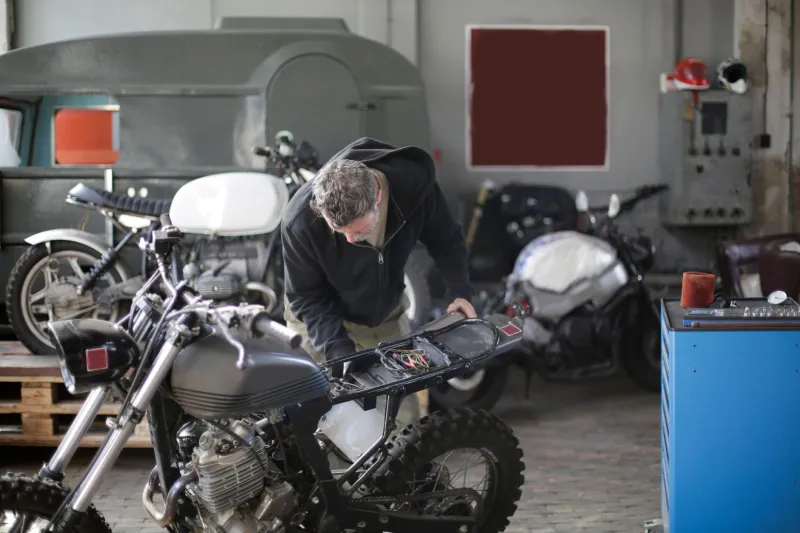
At Honda Motor Bandung, every trade-in begins with a frame inspection that goes beyond checking for visible cracks or bends. Technicians look for stress patterns near welds, signs of previous impact repair, and subtle misalignment that suggests the motorcycle has been involved in a collision that was never properly disclosed. In the US, many riders are unaware that even a low-speed tip-over, if handled poorly during repair, can introduce structural compromise that dramatically reduces resale value.
If you are preparing to trade in your Honda, have the frame inspected by a qualified technician before the dealer does it for you. Knowing what exists allows you to price accordingly—or address it in advance.
Engine and Drivetrain Wear Patterns
Our technicians perform compression tests and listen for specific acoustic signatures that indicate piston ring wear, valve clearance issues, or early bearing degradation. These are not problems that a visual inspection catches. They require equipment and trained ears. In high-mileage US bikes—particularly those that have been ridden hard on highways or in stop-and-go urban traffic—these wear patterns appear at predictable intervals that most riders are not tracking.
American Honda owners should request a full engine health check before entering any trade-in negotiation. Understanding where your engine sits on the wear curve gives you leverage and removes the element of surprise that dealers often use to justify lower offers.
Electrical System Condition
This is an area where US dealers frequently underinspect, and where Bandung's standards diverge most sharply. Humidity-driven corrosion inside connectors, around battery terminals, and within the wiring harness is one of the most common sources of hidden value loss in used Honda motorcycles. While Bandung's climate makes this problem more acute, American bikes ridden in coastal regions, rainy climates, or through winter road salt are equally susceptible.
Our inspection process involves checking every major connector for oxidation, testing voltage output under load, and examining the integrity of insulation along primary wiring runs. A compromised electrical system is expensive to repair and difficult to disclose honestly without losing the sale. Knowing your bike's electrical health before the trade-in conversation begins puts you in a far stronger position.
Suspension and Brake System Depth
Fork seals, shock absorber damping, and brake caliper condition are evaluated not just for current function but for remaining service life. A motorcycle with functional but near-end brakes and leaking fork seals may stop and steer adequately today, but it represents an imminent maintenance cost for whoever buys it next. Indonesian dealers factor that cost into their offer. Many US dealers do not—until after you have already agreed to a price.
Replacing fork seals and brake pads before a trade-in is one of the highest-return maintenance investments an American Honda owner can make. The cost is modest; the impact on perceived and actual value is significant.
The Hidden Cost of Surface-Level Thinking
One of the most consistent findings at Honda Motor Bandung is that motorcycles presented in excellent cosmetic condition often carry deferred mechanical maintenance. Riders invest in appearance because appearance is what they believe buyers and dealers evaluate most. But experienced technicians see through that immediately.
For American Honda owners, the lesson is straightforward: the money spent on a professional mechanical inspection before a trade-in will almost always return more than its cost. Not because it necessarily improves the bike's condition, but because it removes uncertainty—and uncertainty is what dealers use to justify their lowest offers.
Preparing Your Honda the Right Way
If you intend to trade in or sell your Honda within the next six to twelve months, the preparation process should begin now. Start with a comprehensive service visit that addresses all outstanding maintenance items. Document every service with dated receipts. Have the frame and electrical system inspected by a technician you trust. And approach the trade-in conversation with data rather than optimism.
The standards applied at dealerships like Honda Motor Bandung exist because the market demands accountability. The US market is moving in the same direction—buyers are becoming more sophisticated, and dealers who rely on information asymmetry are finding that advantage eroding.
Knowing what your Honda is truly worth—not just what it looks like it is worth—is not a defensive posture. It is the foundation of an honest transaction, and the starting point for whatever comes next on two wheels.