The Diagnostic Skills Drain: What Happens to Your Honda When Your Mechanic Relies on a Scanner Instead of Knowledge

There is a particular kind of frustration familiar to American Honda motorcycle owners who have spent time in a dealership waiting room. The technician runs a diagnostic scanner, reads a fault code, replaces the component the code points to, and hands back the bike with a bill. Two weeks later, the same symptom returns. A second scanner session produces a different code. Another part is replaced.
This cycle is not simply inconvenient. It is expensive, and it is becoming more common. Behind it lies a structural problem that the American motorcycle service industry has been slow to acknowledge: the gradual erosion of genuine Honda-specific diagnostic expertise among working technicians.
When the Scanner Becomes a Crutch
OBD diagnostic tools are legitimate instruments. Used correctly, by a technician who understands Honda engineering, they accelerate accurate diagnosis. The problem is not the tool itself—it is the increasing tendency to treat a fault code as a final answer rather than a starting point.
Honda motorcycles, particularly the modern lineup from the CB series through the Africa Twin, are engineered with specific tolerances, fuel mapping logic, and valve timing characteristics that interact in ways a generic scanner cannot fully interpret. A fault code indicating a lean fuel condition, for example, might originate from a faulty oxygen sensor, a clogged injector, an air leak in the intake tract, or a degraded throttle position sensor. The code identifies a symptom. It does not identify a cause.
A technician with deep Honda-specific knowledge reads the code and then begins mechanical investigation: listening to idle behavior, checking fuel pressure against Honda's published specification, inspecting vacuum lines by hand, evaluating throttle response at different RPM ranges. The scanner is one input among many. For a technician whose diagnostic vocabulary is limited to fault codes, it becomes the only input—and that limitation costs owners money.
The Skills Gap Is Structural, Not Individual
It would be unfair to characterize this as a failure of individual technicians. The skills gap has structural roots.
American vocational training programs for automotive and motorcycle technicians have increasingly oriented around computerized diagnostics, partly because modern vehicles demand it and partly because scanner-based diagnosis is faster to teach and easier to standardize. The hands-on, model-specific mechanical education that produces technicians who truly understand Honda engineering—how a particular engine breathes, how its cooling system behaves under sustained load, what a specific transmission sounds like when it is developing a wear pattern—requires time, volume, and mentorship that many American training programs no longer prioritize.
The result is a generation of technicians who are competent with diagnostic hardware but less confident with mechanical judgment. As senior Honda specialists retire, the institutional knowledge they carry is not being systematically transferred. It is, in many cases, simply disappearing.
What High-Volume Service Environments Produce
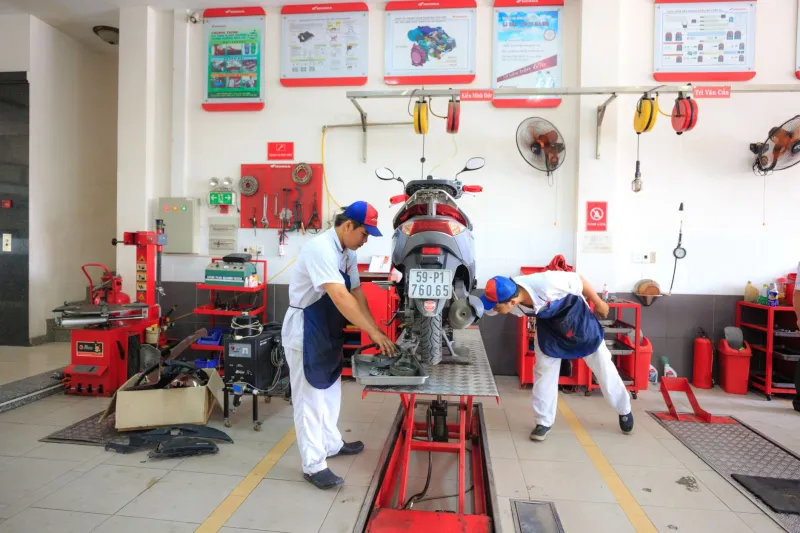
At Honda Motor Bandung, the service environment operates at a scale that most American dealerships never approach. Technicians there handle a concentrated volume of Honda motorcycles daily, across a wide range of models, engine configurations, and usage profiles. That volume creates something that cannot be replicated in a low-throughput service center: pattern recognition built from direct mechanical experience.
A technician who has serviced two hundred Honda PCX scooters develops an intuitive familiarity with the way that engine sounds, responds, and fails. They recognize a developing cam chain issue not because a scanner flagged it, but because the idle note has shifted in a way they have heard before. They catch a carburetor hesitation that no fault code will ever generate, because the problem exists in a mechanical interaction rather than an electronic signal.
This kind of diagnostic depth is not mystical. It is the product of repetition, attention, and an environment that demands genuine mechanical understanding rather than code-reading efficiency. It is also, for American Honda owners, increasingly difficult to find.
The Financial Cost of Shallow Diagnosis
The wallet impact of scanner-dependent diagnostics is not theoretical. Consider the common scenario of a Honda CB500 developing an intermittent rough idle. A scanner-first diagnosis might generate a throttle position sensor code, resulting in a sensor replacement at roughly $180 in parts and labor. If the actual cause is a partially clogged fuel injector—a mechanical issue that produced the sensor reading as a secondary effect—the idle problem will persist. A second diagnostic visit, another code, another replacement. The owner may spend $400 to $600 before a mechanically literate technician identifies the root cause in twenty minutes of hands-on investigation.
Multiply that dynamic across the lifetime of a motorcycle, and the cumulative cost of shallow diagnostics is substantial. Worse, some misdiagnoses do not just cost money—they allow real mechanical problems to progress while owners believe they have been addressed.
How American Riders Can Protect Themselves
The most effective protection against diagnostic incompetence is selectivity about where a motorcycle is serviced.
Before committing to a service center, American Honda owners should ask direct questions: How many Honda motorcycles does this shop service per month? Are any technicians Honda Master Technician certified? When a fault code appears, what is the shop's process for verifying the root cause before ordering parts?
A service center that answers these questions confidently, with specifics, is demonstrating the kind of mechanical culture that produces accurate diagnosis. A service center that responds vaguely or pivots immediately to scanner capability is signaling a different set of priorities.
Owners should also trust their own mechanical instincts. If a bike returns from service with the same symptom, pushing back is appropriate. Requesting a detailed explanation of how the diagnosis was reached—not just what code appeared—is a reasonable expectation, not an unreasonable demand.
The Standard Worth Seeking Out
The diagnostic approach practiced at Honda Motor Bandung—where scanner data informs but does not replace mechanical investigation—represents a standard that American Honda owners deserve from their service providers. It is not an exotic or unachievable standard. It is simply what genuine Honda expertise looks like when it is applied consistently.
As the skills gap in American service centers widens, finding that standard will require more deliberate effort from owners. But the financial and mechanical stakes of settling for less make that effort worthwhile. A technician who truly understands your Honda is not a luxury. Over the life of the motorcycle, they are among the most valuable relationships you can maintain.