When the Rain Never Stops: Indonesian Storage Secrets That Fortify Every American Honda Garage

Bandung sits at roughly 2,400 feet above sea level, surrounded by volcanic highlands that funnel moisture-laden air across the city for months at a stretch. During the wet season, relative humidity regularly climbs above 85 percent, and the rain does not merely fall—it saturates. Motorcycles parked in open-air shelters, semi-covered workshops, and even closed garages absorb that moisture in ways their owners rarely anticipate until a technician opens the fuel tank or pulls a corroded brake line.
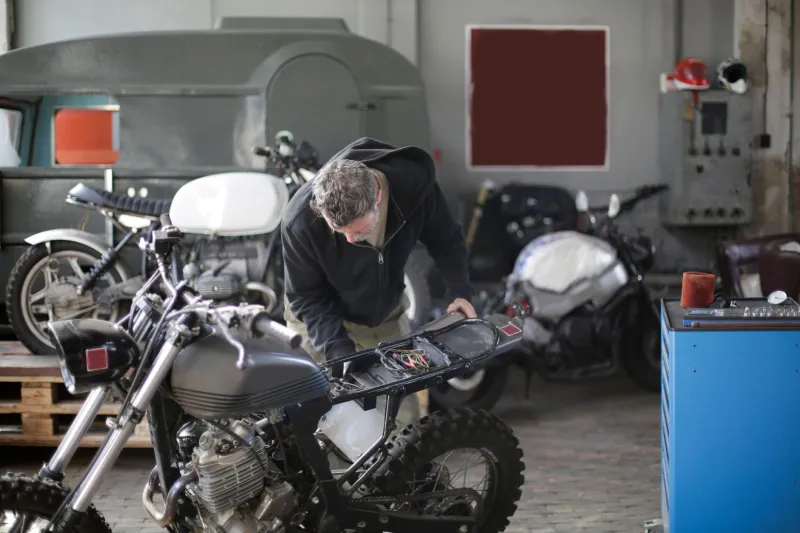
At Honda Motor Bandung, we see the consequences of that environment every single day. What surprises many of our American visitors and online readers is how closely those consequences mirror what happens inside a typical US garage—particularly in the Pacific Northwest, the Gulf Coast, the upper Midwest, and anywhere else where seasonal humidity swings are significant. The difference is that Bandung's mechanics have been forced to develop solutions. Most American riders have not yet recognized that the problem exists.
This article changes that.
The Myth of the "Safe" American Garage
A closed garage feels protective. It keeps rain off the seat, blocks direct sunlight, and creates a sense of controlled storage. For an automobile, that level of protection is often sufficient. For a motorcycle—with its exposed metal surfaces, smaller fuel volume, and intricate carburetor or fuel injection components—a closed garage can actually concentrate moisture rather than eliminate it.
Here is the mechanism: when outdoor temperatures drop at night, the air inside a sealed garage cools as well. Cooler air holds less water vapor, so the excess moisture settles as condensation on the coldest available surfaces. On a Honda motorcycle, those surfaces include the chrome exhaust headers, the steel frame, the fuel tank seams, the battery terminals, and the interior walls of the air filter housing. This process repeats nightly throughout autumn, winter, and early spring across most of the continental United States.
In Bandung, the same condensation cycle occurs with even greater intensity because the baseline humidity is so much higher. The result, as our service team observes routinely, is rust forming inside fuel tanks after just one prolonged storage period, carburetor jets becoming partially blocked by oxidized residue, and electrical connectors developing the green-white corrosion that interrupts clean signal transmission. These are not catastrophic failures that announce themselves loudly. They are slow, quiet degradations that accumulate across multiple storage seasons and eventually present as difficult-to-diagnose performance issues.
Fuel First: The Overlooked Interior Threat
Of all the moisture-related failures our technicians document, fuel system deterioration is among the most preventable and the most frequently ignored by American riders. Modern gasoline—particularly ethanol-blended fuel common throughout the United States—absorbs atmospheric moisture readily. When a Honda sits for four to six weeks with a partially filled tank, that ethanol-water mixture begins to separate, leaving a phase-separated layer at the bottom that will not combust cleanly and will corrode metal surfaces on contact.
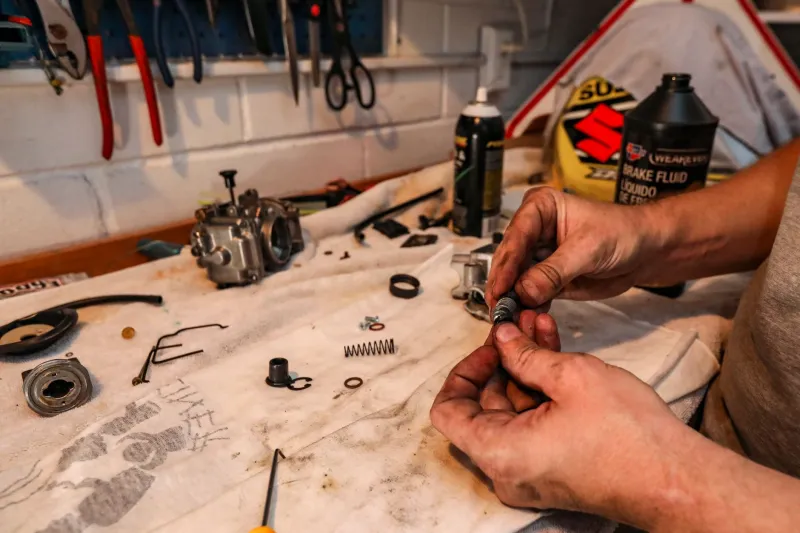
Bandung's approach is straightforward: never store a motorcycle with a partially filled tank, and never store it with untreated fuel. A full tank minimizes the air space available for moisture to occupy. A fuel stabilizer, added at the correct ratio before the final ride of the season, prevents oxidation and phase separation for up to twelve months. These two steps alone eliminate the majority of fuel-related storage failures our service center addresses.
For American riders in humid climates—Florida, Louisiana, coastal Georgia, the Pacific Northwest—we recommend treating fuel at any storage period exceeding three weeks, not just the traditional winter layup. Moisture does not observe seasonal calendars.
Breathing Barriers: Controlling the Air Your Garage Exchanges
One of the most cost-effective investments a Honda owner can make is a dehumidifier sized appropriately for their garage space. In Bandung, our partner workshops use industrial-grade dehumidification as a baseline standard. In a typical two-car American garage, a residential dehumidifier rated between 30 and 50 pints per day is sufficient to maintain relative humidity below 50 percent—the threshold at which steel corrosion rates drop dramatically.
For riders who prefer a lower-cost approach, desiccant packs placed strategically near the motorcycle offer meaningful supplemental protection. Silica gel containers positioned inside the seat compartment, near the air filter housing, and adjacent to the battery are particularly effective. These are replaced or recharged every 60 to 90 days depending on ambient conditions.
Garage door seals also deserve attention. Most residential garage doors allow significant air infiltration along the bottom and sides. Replacing worn weatherstripping reduces the volume of humid outdoor air entering the space during overnight temperature drops—a small investment that pays dividends across every subsequent storage season.
Covering Correctly: What the Material Actually Does
Motorcycle covers are widely used and widely misunderstood. A cover that traps moisture against the machine is worse than no cover at all—it creates a humid microenvironment directly against every painted and metal surface. In Bandung, where motorcycles often must be covered in open-air parking during active rainfall, our recommendations to customers are specific: use only covers rated as breathable, and never apply a cover to a motorcycle that has not been allowed to cool and dry completely after riding.
For American garage storage, a breathable indoor cover serves primarily as a dust barrier and a psychological comfort. The more meaningful protection comes from the environmental controls described above. If a cover is used, ensure it does not contact the exhaust system during the cooling period immediately following a ride, as trapped heat accelerates condensation formation beneath the fabric.
Battery and Electrical Preservation Under Humidity
Lead-acid and lithium motorcycle batteries both discharge more rapidly in cold conditions, but humidity introduces a secondary threat: terminal corrosion that increases internal resistance and reduces the battery's ability to deliver clean starting current. At Honda Motor Bandung, we document a measurable increase in battery-related service calls during and immediately after the wet season—a pattern that mirrors what American Honda dealers see in late winter and early spring.
A battery tender or smart charger connected throughout the storage period addresses the discharge problem. Applying a thin layer of dielectric grease to the terminal connections before storage addresses the corrosion problem. Together, these steps cost less than twenty dollars and reliably extend battery service life by one to two seasons.
The Compound Return of Consistent Preparation
What Bandung's monsoon season teaches, ultimately, is that motorcycle storage is not a passive event. It is an active preparation that determines the condition of your Honda when the riding season returns. The mechanics at Honda Motor Bandung have refined these protocols through necessity—when the rain arrives and stays for months, there is no margin for casual storage habits.
American riders operate in environments that are, in most cases, less extreme than Bandung's wet season. But the underlying chemistry of moisture, metal, and fuel is identical regardless of geography. A garage in Portland, Oregon, or Houston, Texas, or coastal South Carolina presents real risks to a stored Honda motorcycle—risks that are entirely manageable with the right preparation.
The strategies outlined here require no major investment and no specialized skills. They require only the recognition that your garage, however solid it appears, is not a perfectly sealed environment—and that a small amount of deliberate preparation, informed by decades of tropical service experience, will return your Honda to the road in the spring exactly as you left it in the fall.